Friday, February 24, 2017

Back to the Future


The Congress Theatre in Eastbourne, the largest on the south coast with a 1700-seat capacity, closed its doors last month whilst it undergoes an interior renovation and the construction of an adjacent welcome building that will house the box office and bar. Due to be completed in late 2018, the refurbishment follows the recent £2 million 5-year overhaul of the exterior. Opened in 1963, this Grade II* listed building has reached a point in its life where it clearly needs some love and attention.

The architects of the building were brothers Bryan and Norman Westwood. Up until then, their Surrey practice had largely been designing laboratories for research institutions and shops, most significantly for long-term client Austin Reed. Such was their expertise in retail design that they produced the definitive text, The Modern Shop, in 1952. After this, they were involved in a wider range of projects that saw them design Liverpool University’s arts precinct, housing for the Greater London Council and the Congress Theatre. It was the Eastbourne theatre that Norman Westwood was said to be most proud of.

Designed in 1958, the Congress was described by the late British-based American architect Rick Mather as having a “Festival-Hall-meets-East-Berlin interior and a dour exterior.” However, it reflected the prevailing trend of the age and its glass, metal and concrete frame frontage are a perfect example of post-war Modernist architecture, whilst its rear elevation owes much to the Brutalist school. Inside, its three-level foyer and the moulded balcony fronts and concealed lighting of the auditorium do, as Mather said, create a Soviet-style atmosphere. Indeed, the last time I was there was to witness the cultural orthodoxy of Reeves and Mortimer.

I first went to the Congress when I was on holiday with my mum and dad at Pevensey Bay. The building would have only been seven or eight years-old then and I do remember it being an exciting and impressive sight for a child of roughly the same age: towering above me on a warm summer’s night, light shining out from its pellucid front, it looked like the future. When I moved to East Sussex permanently a dozen years ago, time had dimmed that memory and the Congress looked as though it was something from the distant past. Next year, hopefully, the future will be back.

Wednesday, February 22, 2017

Sussex in the City


The common assumption is that modernism belongs to the city: as a form and a concept, it is popularly thought that modernist art, writing and ideas are essentially a reflection of the urban experience. There are dissidents, however: in The Country and the City, the Welsh cultural academic Raymond Williams rejected the opposition of the country as a pastoral idyll and the city as the heart of modernity. For Williams, the divide was a myth and there was an inextricable link between the two; he considered modernism a single tradition expressing a sense of common experience.

A new exhibition in London, in a neo-Gothic mansion by the Thames, would seem to support this idea of a link between the country and the city. Focusing on the extraordinary concentration of artists and writers in Sussex in the early 20th century, Sussex Modernism: Retreat and Rebellion challenges the idea of the countryside as an Eden and, instead, presents an area that inspired the experimental and the unconventional.

Created by the Bulldog Trust and curated by Dr Hope Wolf of the University of Sussex, the exhibition contains works from the historical Sussex homes of artists such as Bloomsbury Group painters and designers Vanessa Bell and Duncan Grant at Charleston, and the surrealist art and photography of Roland Penrose and Lee Miller at Farley Farm House in Chiddingly. Also featured is modernist art from the collections of Sussex galleries such as the Jerwood in Hastings and the Towner in Eastbourne, and museums at Ditchling and Brighton.

Many of the artists held and shared socialist beliefs and some saw Sussex as a retreat where they could rebel against traditional domesticity by living communally or alternatively. Sculptor Eric Gill was part of a Catholic community at Ditchling Common and his alternate lifestyle tested the boundaries of most people’s idea of common decency. What truly united the artists, though, was the pursuit of innovation and the production of work that challenged traditional ideas about the countryside in the modern age.

Sussex Modernism: Retreat and Rebellion is at Two Temple Place, Victoria Embankment, London WC2R 3BD until 23rd April 2017. Admission is free.

Saturday, February 11, 2017

Understated


On stage at the Green Door Store in Brighton last night, everything about Nadia Reid’s set was intimate and understated: she asked for the stage lights to be dimmed an inch, for the monitors to be turned down a little and for the audience to shuffle a step nearer the stage to let the rest of the sold-out crowd in at the back of this tiny venue. And then there was the most intimate thing of all: Reid’s voice. Crystal clear and unaffected, she sings with a beauty and a purity that renders her folk/country songs tender and emotional without recourse to histrionics.

I was alerted to this young singer/songwriter’s debut album, Listen to Formation, Look for the Signs, early last year when it was given a glowing review in Mojo magazine. It was only when it failed to figure in 2016 ‘best of’ lists that I discovered that it had been released the previous year; further digging revealed that it actually came out in 2014 in her home country of New Zealand. That she had made such an assured and mature debut at the ridiculously young age of 23 was further evidence of her prodigious talent. Added to this, her admission that she took seven years to write the songs for the album meant that her debut was the sound of her whole adult life: small wonder it is such a considered and confident album.

With Reid on acoustic guitar and Sam Taylor accompanying her on electric guitar, they replicated the haunting Appalachian sound of the album superbly: Holy Low was dedicated to a baby in the audience (yes, a tiny baby) who was born to the sound of Reid’s songs and the sublime Ruby (“Where did my love go? He was the sailor of my ship”) was played at the audience’s request. Even though they were performing as a duo – it is financially prohibitive to bring the whole band over from New Zealand, Taylor told us when we chatted to him after the gig – rockier tracks, such as Reaching Through, were given full rein. The title track from the new album, Preservation, was an indication that the new songs are just as ethereal and, with her material attracting a lot of airplay on 6 Music, she may not be able to remain understated for much longer.

Preservation is released on Basin Rock on 3rd March.

Friday, January 27, 2017

Trudge Life


At one point on stage at the Con Club in Lewes last night, bass behemoth Jah Wobble chuckled to himself that he loves “trudging through the Wobble back catalogue.” If this was trudging, I highly recommend it. Him and his fantastic Invaders of the Heart propelled us through two hours of sterling musicianship, wise-cracking philosophy and some stellar tunes – all underpinned by Wobble’s low-frequency basslines.

It is not all sternum-shredding sub-bass, though: I last saw Jah Wobble in the early 90s when I went to a couple of his gigs in London at the Jazz CafĂ© and the Astoria. This was at the time of his commercial apex with the Rising Above Bedlam album and I remember, at the Astoria gig in particular, being almost induced into a transcendent state by the higher power of the rising and spiralling bass on Visions of You. The same happened again on that song last night and on the final encore, a rendition of Public Image’s Poptones, which must be one of the most gloriously hypnotic basslines ever created.

There were other examples of his work with PiL in the seventies: a drum and bass version of Socialist from Metal Box; a skanking version of the debut single; an epic treatment of the sprawling closer from the debut album, Fodderstompf – still with falsetto chant of “we only wanted to be loved!” But Wobble had a life beyond Lydon and Levene and has an impressive range of collaborations to his name: he has worked with Paul Oakenfold, The Orb and Primal Scream from the dance end of the spectrum and, from the avant garde, Brian Eno and members of Can. How Much Are They?, from his eighties' work with the latter’s Holger Czukay and Jaki Liebezeit, gets an outing and Liebezeit, who passed away this week, is remembered fondly as “the best drummer I ever played with.”

These days, Wobble also strays beyond his own material: the Harry J. Allstars’ Liquidator gets the audience dancing – some of it interestingly interpretive – and features an interval with Wobble at a metaphorical mixing desk orchestrating an hilarious zoomorphic description of all the instruments in the band; and one of the encores is jazz musician Roy Budd’s theme from the 1971 film, Get Carter, with flashes of Jeff Clyne’s elastic bassline.

With a two-hour set and three encores, it was a great gig; band and audience seemed to really enjoy themselves and Wobble cut a dash in his trademark pork pie hat as he prowled the stage. At one point he even choreographed some moves with the guitarist and trumpeter - but they were swaying not trudging.

Sunday, January 22, 2017

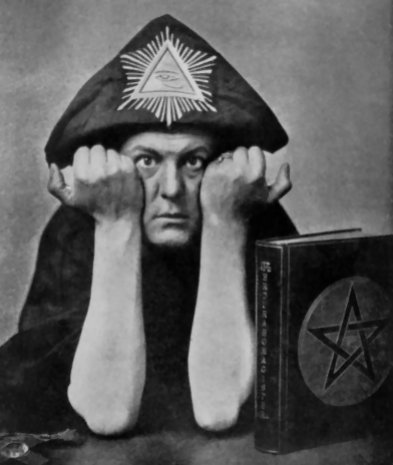
Do What Thou Wilt


On the 1st December 1947, a 72 year-old man died at the Netherwood Guest House on The Ridge in Hastings. He had lived there for two years and had been in ill health throughout that time; he finally succumbed to chronic bronchitis, pleurisy and heart disease. This was not an unusual occurrence for a seaside town boarding house with an elderly clientele. And this particular guest was typical: he had spent his days unremarkably, taking local walks and beating all-comers at Hastings Chess Club. What had marked him out from the others, however, were the parcels he received from around the world, occasional visitors from London and Europe and the fact that he spent the nocturnal hours in his room at Netherwood reading, writing and taking heroin.

The elderly man was Aleister Crowley and his incredible life had led him, not many years before, to be regularly dubbed ‘the wickedest man in the world’ by the tabloid press. An occultist, he had devoted his life to the search for wisdom through an exotic mix of mysticism, paganism, magic, sex and drugs - it was the last three that really got the press going. Born into a wealthy family in Leamington Spa, Crowley had rejected his fundamentalist Christian upbringing and, in his early twenties, joined The Golden Dawn occult society and was soon practicing ceremonial magic. His inheritance allowed him to travel and, after spells in Mexico, Egypt, India and China, where he studied religions and climbed mountains (he was a serious mountaineer), he published The Book of Law, espousing the idea that people should be free to follow their own will. This book, and its motto ‘do what thou wilt’, had supposedly been dictated to Crowley by a messenger from the Egyptian deity Horus and it became the cornerstone of his own religion, Thelema.

Crowley also established an order, the A:.A:., based in Victoria in London, where his religion was practiced. He had become interested in the ritual use of drugs – particularly hashish – in his search for objective truth and had been privately experimenting with bisexuality and sadomasochism. Influenced by his close links with a German occultist group, Ordo Templi Orientis, Crowley began to incorporate ‘sex magick’ – the use of sexual activity and arousal - into his Thelemic ceremonies. His spelling of ‘magick’ was to differentiate his sorcery from the popular stage magic of the early 20th century.

Crowley’s chaotic personal life – one of his two daughters had died of typhoid in Burma and his alcoholic wife had been institutionalised in Britain - worsened as his money ran out. He was a prolific writer of books on mysticism but also wrote poetry, plays and articles; and when war broke out in 1914 he travelled to the United States and earned a living there as a journalist writing for Vanity Fair and other publications. He became involved in the pro-German movement in New York and wrote for the propaganda newspaper, The Fatherland. This led him to be condemned as traitor in Britain but Crowley had been, in fact, working as a double agent for British intelligence.

Back in London after the war, he was prescribed heroin to treat his asthma and so began an addiction that would stay with him for the rest of his life. He published Diary of a Drug Fiend in 1922 and was demonised in the popular press as a result. This was compounded when details began to emerge of the goings-on at the Abbey of Thelema that Crowley had established in Sicily. Stories of degradation and depravity led to the Sunday newspaper, John Bull, declaring him to be 'a man we'd like to hang'. In 1923, he was deported back to Britain by the new young Italian Prime Minister, Benito Mussolini.

In the 1930s, Crowley continued his nomadic existence moving from Tunisia, to France, to Germany. He wrote his autobiography in Paris and exhibited paintings in Berlin before moving back to London at the start of the Second World War. After periods in Devon, Buckinghamshire and Surrey, he settled, for the last time, in Sussex in 1945. After his death, he was cremated in Brighton where one of the few mourners read from The Book of Law. The tabloids reported his final ceremony as a Black Mass but were disappointed in the lack of sex and drugs.

Tuesday, January 10, 2017

Fantastic Voyage


If I were a person uninterested in David Bowie, and I am prepared to concede there could be the odd one or two of them out there, then I may be a little puzzled over the intensity of the reaction to the release of his final two albums, his death last January and its anniversary this week. But I am passionate about Bowie and I have been unashamedly emotional since the song Where Are We Now? appeared online out of the electric blue on his birthday in January 2013. That morning, John Humphrys broke the news that put an end to my anxiety that Bowie was at death’s door: throughout the previous few years, I had been boring my family rigid with my fears every time I checked his frozen and unyielding website. To find out that he was making music, that he was in the world, was a relief; oh, the irony.

David Bowie has been a constant in my life since I was ten years old. Not the legendary 1972 Starman Top of the Pops appearance for me - being a summer evening I was probably still out playing football when that was aired; Bowie first captured my attention in the autumn of that year listening to John I’m Only Dancing on Radio Luxembourg. Two things stood out: the relationship confusion (“John, I’m only dancing/she turns me on/but I’m only dancing) and Mick Ronson’s stuttering guitar feedback at the song’s close. From there on in I was hooked: those seventies albums were my comforts in the misery of being a teenager. Bowie made it acceptable to be creative, different and even pretentious in a brutal time. I first picked up a guitar because of Bowie, he introduced me to Lou Reed and the Velvet Underground, and he turned me onto books with his trilogy of Orwell-inspired songs on Diamond Dogs. Most of all, he made me look at the everyday differently (“It was cold and it rained and I felt like an actor”) and he made the world romantic (“I’ll kiss you in the rain”). It rained a lot in the seventies.

Locked away in the back bedroom of a south-east London council house, I listened to little else until punk came along; but even then I never neglected Bowie and I wrote about his music, and its influence on punk, in the fanzine I produced with my mates. Expelled from school in late 1977, I then had to travel some distance to attend Bowie’s alma mater in Bromley for the fag end of my secondary education. I scoured the year photographs in the corridor and there was the class of ’63: rows of boys with short back and sides and National Health specs all facing the camera lens. Except for one. There was Bowie. Unmistakeable: level gaze, blonde quiff, three-quarter profile. He watched over me like a guardian angel for the torrid six months I was there.

It was only those two dreadful albums in the late eighties that caused me to temporarily lapse my faith; but in the nineties, a decade overlooked in the current reappraising of his career, his voyage was back on course again. In 1993, he released two redemptive albums: Black Tie White Noise and the largely ambient The Buddha of Suburbia. I had recently learned to drive (always a late starter) and that year, thrilled with the novelty of car travel, I used to take pointless journeys around London with these as my soundtrack; and when my parents died in 1999 it was his album Hours (“I’ve danced with you too long” - anyone who has not heard Something in the Air really should) and, a few years later, Heathen (“how I wonder where you are”), that I think of fondly now as my bereavement counselling.

Then came the hiatus, so thrillingly ended with The Next Day, and then the stellar swansong. I was in Victoria in central London on the day Blackstar was released and – a sign of the times, this - I could not find a shop anywhere where I could get the album; I ended up buying it in a supermarket when I got off the train back in Sussex. All that weekend the house was filled with the sound of yet another Bowie step change: the driving jazz of Donny McCaslin’s band mixed with the tender balladeer of old. And then on the Monday morning, it was Nick Robinson who broke the news of Bowie’s death. I was making breakfast for the kids and involuntarily burst into tears. They had never seen me cry before and were stunned. So was I. Not that I don’t cry - I do - but I have always thought that it would be unsettling for young children to see a parent so upset. Very quickly people were sharing their grief, and what Bowie had meant to them, publicly on social media. The trolls were not far behind, generally following the ‘it’s-not-about-you’ line. But they were wrong: it was about us and it still is. Yes, a man had died and his family were grieving but so were we. Those of us, like me, for whom Bowie was important, were feeling the loss acutely. I realised that morning, he had been in my life longer than my parents had.

How could this be when Bowie was essentially a remote figure? I did not know him; he was a huge rock star; I had never even seen him live. Having been to countless gigs, the latter may seem odd but, when I was 10 years old, the idea of going to a concert was as remote to me as visiting Mars. By the time I realised that seeing Bowie live was a possibility, I was forbidden by my dad from going to the Wembley Empire Pool gig my older sister went to in 1976. There were two reasons for this: he had reacted badly to the half man half hound cover of Diamond Dogs and he had seen Alan Yentob’s Cracked Actor TV documentary when I had been allowed to stay up late to watch it in 1975. Bowie was at his emaciated worst and my dad kept repeating the same two words throughout - the first was an expletive and the second was “weirdo.” Looking back, my dad’s judgement was decidedly suspect: he would not let me anywhere near David Bowie but he had let me and my sister go and see Gary Glitter perform at an open air fun day when we were on holiday in Hastings.

By the time I left school and my dad had given up telling me what to do, I was a punk and, on the 1978 Isolar II tour, Bowie played Earls Court, the sort of impersonally large venue that belonged to a less egalitarian age. Caught between a rock and a hard place of my desire to see David live and the preservation of my punk credentials, I was in a quandary. Then I read an interview in Ripped & Torn fanzine with Siouxsie, Bowie fan and leader of my favourite punk band at the time: she was asked whether she would be going to Earls Court and she replied that she wouldn’t go to a venue like that for anyone. My decision was made - I stayed away.

There was a gap of five years before he played live again and, having overcome teenage credibility issues, I got tickets to see him on the Serious Moonlight stadium tour; but in the wake of Let’s Dance, he had become massive in the mainstream. When one of my best friends expressed his horror that I was prepared to share Bowie with so many thousands of Johnny-come-latelies - “He won’t be playing Memory Of A Free Festival or Quicksand, you know?” - I sold my tickets. And then it dawned on me: I could never share him with anyone else and, despite numerous opportunities later on, I never did. He was the most important cross-cultural person of the last 45 years but he was my mentor, my personal tutor; he enriched my experience of culture – of music, literature, art and film - and I think that is why I mourn him selfishly, as if he were mine alone.

Friday, December 30, 2016

Fog and Ice


The post-mortem having started in June, more than enough has already been said about the awfulness of 2016; and more than enough has probably been said in contrast in recent weeks as we desperately attempt to salvage something from the year; but every time we focus on the good – Sadiq Khan’s London Mayoral victory, the British Olympic team – more bad events that had momentarily slipped our minds – the Nice truck attack, the Orlando nightclub shooting – come swimming back into view.

It is undeniable - 2016 has been a terrible year: it started with the loss of our brightest lodestar who, having shone once more, shockingly fell from earth a couple of days later; and the year comes to a close, after a series of seismic political events, with the feeling that human decency is firmly out of favour. Unquestionably, it has been a year that is difficult to make sense of and, although I have had plenty of time on my hands over the Christmas break to read, listen, walk and reflect, I am no closer to having any idea what 2016 meant and what 2017 will bring. So, I stopped thinking too hard when out walking the dogs this week and, instead, enjoyed the weather and landscape on my doorstep.

I started my walk under a clear blue sky, tramping across fields as hard as iron under early morning frost on the way down to Wartling Wood, skirting Herstmonceux Castle on the way back and resting at the top of the ridge above Herstmonceux Place. There is some history between the two buildings: the 15th century moated castle was ransacked by its owners, the Hare-Naylor family, in 1777 to provide the interiors for their new country house over the hill at Herstmonceux Place. The castle won through in the end, however: in the 20th century, it was restored to its former splendour and the Georgian house suffered the ignominy of being divided into flats.

By the time of the final leg of my walk, up through Comphurst Wood to home, I was tired but bathed in warm December sunshine. I took this route each day this week and it felt good for the soul. That was until today: this morning the woods and fields were wreathed in a dense fog and the air was palpably icy on my face. I completed my usual circuit but the sun did not break through, the landscape remained unilluminated, and I returned cold and unsatisfied from a disorientating and claustrophobic walk. It was hard not to feel that this was a more fitting end to 2016. Happy New Year.