Friday, September 29, 2017

Something Special


Facing a three-way clash on the Saturday afternoon at the recent End of the Road festival, I used Luke Rhinehart's The Dice Man method of making a choice and ended up seeing all of Bill Ryder-Jones, most of Nadine Shah but none of DUDS. I bitterly regretted missing out on the Mancunian band, whose 2016 EPs, Unfit For Work and Wet Reduction, I had heard on Marc Riley's show. However, on returning from the festival I found out they were playing in Brighton in a mere few weeks, so all was not lost.

That date rolled around last night and I went off to the Green Door Store expecting to hear the quirky guitars and skittering post-punk rhythms of their previous output. I was not disappointed: there was clear evidence in their sound of angular bands like early XTC and Scritti Politti; but what I was not expecting was how dynamic their stage performance would be and how their music seems to have moved on in the past 12 months. To begin with, they have expanded from a band of four to a seven-piece, incorporating vocals, two guitars, bass, drums, percussion, trumpet and cornet; also, they massed on the tiny stage all dressed in identical dark grey short sleeve shirts and trousers, making them seem like a gang and creating an imposing presence; and the sheer ferocity of the playing took the breath away.

With the expansion of the band, DUDS' sound has developed into a full-on dissonant No Wave experience. Incredibly tight, the bass, drums and percussion were a rhythmic assault and the discordant guitars and blasting brass gave no let-up: with no song longer than a couple of minutes, their brief and relentless - and encoreless set - left the audience exhausted and in no doubt they had witnessed something special.

They finished with No Remark, the opening track of their just-released album, Of A Nature Or Degree (12 tracks, 23 minutes). I picked up a copy at the merch stall afterwards and, chatting to the band, it came as no surprise that their music is characterised by short bursts of rhythmical energy when they cited The Contortions, Blurt and Wire as influences.

Of A Nature Or Degree is out now on Castle Face Records.

Monday, September 25, 2017

Day of the Hunters


A few Saturdays ago, residents of the village where I live were woken early in the morning by the roar of 4 x 4 engines and the clatter of horses’ hooves. Not unusual sounds in the countryside but it was the multiplicity of the vehicles and the mounts that disturbed the sleep of so many: the hunt had arrived. By the time I was out walking my dogs, members of the East Sussex and Romney Marsh (ESRM) hunt were gathered on local farm land, with hounds, preparing to hunt. They were not alone: a group of protestors from the South Coast Hunt Saboteurs were there to monitor their activities.

When hunting with dogs was made illegal in 2005, hunt associations invented trail hunting as a means of continuing to operate. Trail hunting involves hounds - still trained to follow live quarry - following an animal-based scent in areas where the presence of live quarry is likely. In its 2015 report, Trail of Lies, the International Fund for Animal Welfare (IFAW) concluded that trail hunting is overwhelmingly being used as a smokescreen to continue illegal hunting. Detailing evidence from over 4,000 field reports by hunt monitors, the report said that most hunts were not even bothering to lay a trail and were encouraging hounds to hunt live animals and claiming any kills as accidents. The IFAW report concluded that “trail hunting is primarily a false alibi to avoid prosecutions of illegal hunting, rather than a harmless temporary simulation of hunting before the ban.” At its Annual General Meeting next month, the National Trust will vote on a resolution to end the practice of granting licences for trail hunting on its land. The proposers cite evidence that illegal hunting is taking place on the Trust’s land under the guise of trail hunting. You do not have to attend the AGM to support the resolution; I have just supported it by returning my postal proxy vote and all National Trust members can do the same by 13th October.

It goes without saying that fox hunting is ritualistic cruelty and this anachronism was rightly outlawed by The Hunting Act 2004. However, it seems that it is still taking place and the South Coast Hunt Saboteurs claim that the ESRM were cub hunting when they were in my village earlier this month - the riders were certainly wearing the tweed jackets associated with this type of hunting. Cub hunting is particularly barbaric: young foxes are flushed out of woodland coverts and hunted down by young hounds as part of their training. Even in the hunting world cub hunting is a sordid secret and is given the sanitised title of ‘autumn hunting.’

There was much discussion on our village social media forum after the visit of the ESRM. Of the comments criticising the hunt, some were from principled opponents of hunting but many were from villagers who were simply put out by the inconvenience of the hunt’s arrival in the village: noise, traffic and disruption. But hunting was always about authority and asserting the right to ride roughshod over ordinary folk. However, there was support for the hunt on the forum; people spoke of upholding tradition and the threat to long-established rural ways. And then things got nasty and the administrator closed and deleted the thread as comments from some of the hunt supporters had become abusive and aggressive; well, there you go.

Wednesday, September 6, 2017

At the End of the Road


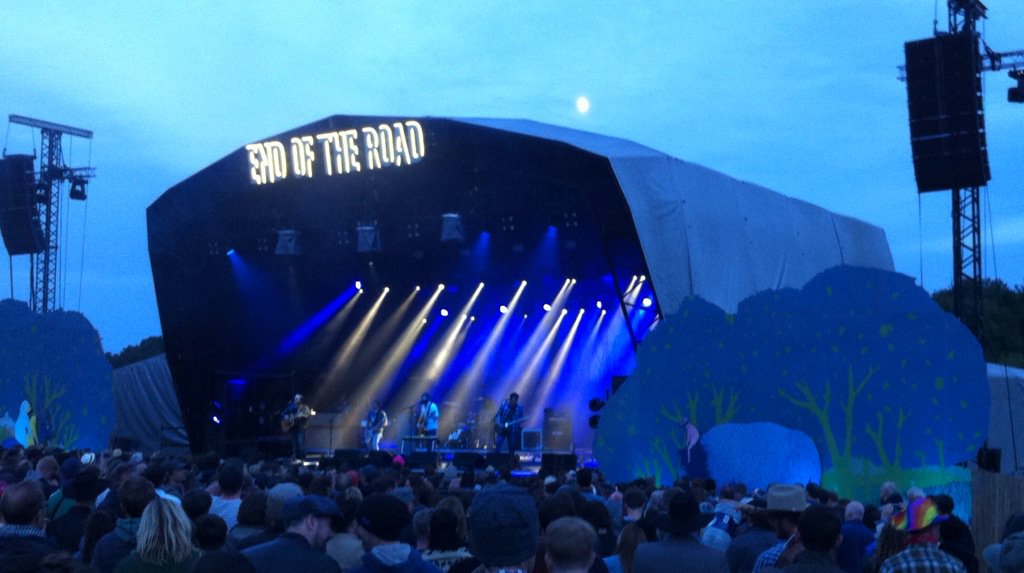
You know a festival is going to be bloody great when the Thursday evening warm-up acts are so good they could easily suffice as the final night line-up. The Wave Pictures/Slow Club supergroup, The Surfing Magazines, get things going nicely in the Tipi Tent with amiable Dave Tattersall’s frantic bluesy guitar work before we dash off to catch The Moonlandingz stomping it up all over The Woods stage. Back in the Tipi Tent Bo Ningen are utterly mesmerising: I have seen the Japanese noise monsters before but at Dorset's End of the Road the frenzy they whip the audience into is without precedent.

The sun was shining brightly at the Garden Stage at lunchtime the next day but Julie Byrne was being a bit precious about some sound problems and played only a truncated set. This was a shame as her album of delicate folk, Not Even Happiness, has been one of the most played at our house this year. A bit later on the same stage, Ryley Walker had no such problems and delivered a blistering set of freeform folk jazz. His band, particularly the bassist, were full of energy and I suspect Walker himself was full of “pints of beer the size of your arm” that he expressed his love of. Over in the Big Top, Aldous Harding’s gothic folk was captivating but the lure of Parquet Courts was too much as their Modern Lovers/Velvet Underground New York sound drifted across the site. Mac DeMarco was the Friday night headliner but I found it difficult to concentrate during the Canadian singer-songwriter’s set as my mind kept drifting back to the band I had just seen in the Tipi Tent. Housewives, a young South London five-piece, were late replacements for Mdou Moctar, who could not appear due to visa problems. They played a bewilderingly intense set of experimental music that left the audience reeling. Their disrupted time signatures and sonic weirdness was one of the best things over the weekend and I can only compare their performance to This Heat, who I saw at the ICA in the early 80s.

Saturday dawned with clear blue skies and a shimmering heat haze and Sinkane, with their blend of afrobeat and reggae, got us all dancing. But I had a horrible dilemma hanging over me: with Bill Ryder-Jones, Nadine Shah and DUDS all playing at the same time I was spoilt for choice. In the end, I caught all of Ryder-Jones' set before legging it up to the Garden Stage to catch most of Nadine Shah; I missed DUDS but, fortuitously, they are playing Brighton later this month. Bill Ryder-Jones was immaculate: playing intimate, tender songs on the largest stage at the festival takes some guts but, mixed with powerful slacker anthems such as Two to Birkenhead and Catherine and Huskisson, he pulled it off - must be time for a new album, though, Bill. Three albums in, Nadine Shah is firmly in her stride: Holiday Destination, which made up the bulk of her set, is a jagged slice of post-punk anger about the xenophobia and anti-immigrant sentiment that seems to define the modern world. By the time I got into the shade of the Big Top stage, I realised that the heat of the day had caused me to visit the cider bus a few too many times. Let’s Eat Grandma were two teenage Kate Bushes let loose in the music cupboard and were very entertaining. Saturday night wrapped up for me at the main stage with Ben Bridwell’s Band of Horses, the perfect band for that twilight moment at a festival: in the fading light, spine-tingling melodies and harmonies rang out across the site on numbers such as St. Augustine, Is There A Ghost, No One’s Gonna Love You, Funeral and, standout track from this year’s Are You Ok? album, In A Drawer.

I was woken on Sunday morning by the patter of tiny raindrops on my tent and, from then on, the drizzle never really went away. But if clothes and boots were damp, spirits were not. A band completely new to me, Nova Scotia’s Nap Eyes, were a delight on the Garden Stage. Their lo-fi guitars and post-punk drums were the perfect canvas for Nigel Chapman’s weary Lou Reed vocals. Nadia Reid’s folk was mature and hypnotic but she still has to sell a lot more tea towels and tote bags to be able to bring over more of her band from New Zealand than just guitarist Sam Taylor. The Tipi Tent was a lock-out for teenage (mostly) girl band Girl Ray, and deservedly so. Their infectious indie-pop melodies lifted everyone’s mood and their set was as fantastic as their album; Don’t Come Back At Ten must be one of the tracks of the year. I was eating my final Goan fish curry of the festival when The Jesus and Mary Chain came on but their white light drew me down to The Woods stage. The resurgence of the Mary Chain has been one of the highlights of the year and the once contrary band now seem like elder statesman of alternative rock. Jim Reid oozes effortless charm (“I hope we’ve been able to cheer you up a bit”) as brother William and his guitar are lost in a Spectoresque wall of sound. Nine Million Rainy Days was apt, Just Like Honey was timeless and the opening line of the closing song was perfect for the captive audience at this superb festival: “I love rock 'n' roll/And all these people with nowhere to go.” I wouldn't be anywhere else; I have already bought my ticket for next year.

Tuesday, August 29, 2017

Border Control


I am in a cottage garden steadily cutting my way through overgrown hazel and hawthorn to re-establish a path that runs along the back of the property. The garden overlooks a field of ripening squash; on the distant horizon, a large dairy herd is lazily chewing grass; the sun is shining and I can feel its late August warmth on my face. I am working outdoors and it is idyllic; I couldn't be happier.

There are, of course, some downsides: rain is forecast tomorrow and I am due to be clearing stinging nettles for someone who has lost control of their borders; I am using some slightly scary and intimidating machinery; I know that, come next month and the one after, wetter weather will appear and the work will become harder and then it will dry up altogether for the winter.

However, I have spent a working lifetime in offices and classrooms and the claustrophobia has overcome me. In a world that has become increasingly complex and hard to fathom out, the pleasure I derive from simply trimming a hedge, strimming a verge or cutting back summer's faded blooms is infinite.

Saturday, August 19, 2017

Mellow Vibes


I have stopped rubbing my eyes when I see who's playing at the De La Warr Pavilion, these days; such is the venue's ability to attract artists - Television, Public Image Limited, The Jesus and Mary Chain, Nelly - who seem at odds with the image of Bexhill-on-Sea as a seaside retirement town, that I am no longer surprised when the likes of Nashville alt-country legends Lambchop roll in to town. Kurt Wagner's loose collective were a distinctly country outfit until the Nixon album of 2000 earned them critical acclaim in this country and the addition of that audience-broadening 'alt' prefix (man, how I hate that 'alt' abbreviation in the current political climate).

Last night, Lambchop were not so much a collective as a trio with Matt Swanson on bass, Tony Crow on piano and wisecracks ("He's from Kansas." "I'm not in Kansas anymore!") and Wagner himself on occasional guitar, drum programming and vocals. On the sleeve notes of last year's album, FLOTUS (not Michelle Obama but an acronym of For Love Often Turns Us Still), one of Wagner's credits was for 'vocal processing' and many of the tracks featured a treated version of his tender voice. Most of the set last night was taken from FLOTUS and the vocoder was much in evidence; it fits perfectly with Lambchop's current sound, which has developed into a repetitive laid-back groove that could be termed soul but would best be described as unique.

Opening with Writer, the set also featured Old Masters and a truncated version of superb eighteen-minute album closer, The Hustle. There were treats from other albums, too, including 2B2 from 2012's Mr. M with it's wry observation, "Yeah, I think it's England/ the dogs they bark at no one". It was an evening of gorgeous mellow vibes and they returned for two more songs by way of an encore. Wagner asked for requests and refused Up With People ("no chance of that until we get a new President") but granted My Blue Wave from Is A Woman, their best album according to my mate, Dave. As if to doff a baseball cap to their soulful antecedents, they finished with an intimate cover of Prince's 1980 song, When You Were Mine.

Tuesday, August 1, 2017

The Courgette Cornucopia


A few years ago, a friend of ours started to behave strangely. Towards the end of the summer term, she would hover around the gates at school pick-up time searching out faces she knew and then thrusting packages into their hands. We would often open our front door to find these packages left, unbidden, on our doorstep. In the summer holidays, even our kids would return from playing at her house with her children, laden down. We would catch sight of her in the village 'cooeeing' friends from a distance as they scuttled into homes and shops. People started avoiding her. We started avoiding her. The thing is, you can only have so many courgettes - and we had enough of our own. What our friend had done was start a vegetable garden at home and, being a novice, plant twelve - yes, twelve - courgette plants. Unable to keep up with the courgette cornucopia, she had been pushed to the brink in trying to find good homes for her produce.

It is a familiar feeling for even experienced home or allotment vegetable growers. A glut is always a risk in a good growing year and courgettes, in particular, have become something of a standing joke. However, getting the plants up and running is not always straightforward. Courgettes can sometimes suffer from germination problems but, providing seeds are not too old and are not subjected to extremes of temperature or moisture, it's hard to fail at this stage. So already there are too many plants and the temptation is to plant out more than are needed to insure against failure. Poor weather, especially high winds in May, can damage young plants and dry spells present difficulties, too: courgettes require plenty of water as well as sunshine to succeed. Pollination can also be a problem when honeybees are not as active in bad weather. One year, I had to hand-pollinate my courgette plants by rubbing the pollen-bearing anthers of a male flower into the centre of a female flower; I didn't know where to look.

This year, we may think we are having a rubbish summer because of the poor weather of the past few weeks but we had a warm May and a flaming June and above average rainfall in both and, as a result, courgette plants are thriving: we currently have a continuous crop from the three plants in our vegetable garden that is just about right for a family of five - but it still feels like we are eating a lot of courgettes. Regular harvesting and consuming is the key and, to get the full benefit of the fruit's flavour, courgettes should be picked when they are not much bigger than a Mars bar. We stumbled across a recipe book by Elaine Borish a few years ago called, What Will I Do With All Those Courgettes?, which has proved invaluable. At the moment, we are eating a lot of vegetable curry, which utilises the courgettes and some of our second early potatoes and also takes care of that other glut we are trying to manage: runner beans.

Thursday, July 27, 2017

Postcards With An Edge


Vintage postcards seem to be a thing these days: no bric-a-brac stall or antique shop is complete without a box of random postcards from the second half of the last century to thumb through and intrude on the past life of people we have never met; Tom Jackson's Twitter account and recently published book, Postcard From The Past, features a series of front images, each accompanied by a very funny Victoria Wood-esque sentence - "Went to see Connie in her new bungalow", "The sight of my box made me homesick for you", "It's all lager and cigars here", etc - from the message on the reverse; and now, tucked away in the first floor gallery at the De La Warr Pavilion, is Roy Voss's delightful exhibition of postcard collages, All The World's A Sunny Day.

Displayed in linear fashion around three walls, Voss's postcards have had a single word cut from the message, and then reversed, so that it appears at a seemingly random point in the front image. Sometimes the word relates literally to the picture, as in 'long' on a postcard of the world's longest pier at Southend-on-Sea, and sometimes a pair or series of cards form a more allusive narrative. I enjoyed the humour of the words 'trip' and 'fall' on postcards of the Matterhorn and Snowdon, respectively, and because of its local interest I was drawn to the dark edge given to adjacent Beachy Heads with the addition of the word 'on' at the cliff top on one, and 'off' at its foot on the other. In fact, Voss seemed to favour prepositions with 'up', 'down', 'over' and 'out' appearing on several images in the exhibition.

As Voss has used postcards from 1960 to 1980, the images had a youthful familiarity for me and I may be guilty of rosy nostalgia for a means of communication that seems to be coming to an end; but the exhibition also resonated less happily with me because of the memory of having to force out every single word on those postcards I was made to write to relatives on childhood holidays.

All The World's A Sunny Day is at the De La Warr Pavilion, Bexhill-on-Sea until 8th Ocober 2017.